
How to Transition Textile Manufacturing to the USA

Table of Contents
Step 1: Assess Your Products and Define Reshoring Goals
Step 2: Run the Cost Math on Domestic Manufacturing
Build the TLC Worksheet
The Three Revenue Inputs Competitors Skip
A Simple Payback Test
Step 3: Find the Right Domestic Contract Sewing Services Partner
What to Look For in a Contract Manufacturer
Step 4: Plan Your Cut and Sew Manufacturing Lead Times
Step 5: Navigate Made in USA Textile Certification Requirements
What "All or Virtually All" Actually Means for Textiles
Qualified Claims and the Disclosure Rules
State and Federal Incentive Programs to Screen
How to Screen Incentives Without Wasting Months
Step 6: Build Supply Chain Resilience and Transparency
Common Mistakes When Transitioning Textile Manufacturing to the USA
Frequently Asked Questions
Last Updated: September 13, 2026
Step 1: Assess Your Products and Define Reshoring Goals
Transitioning textile manufacturing to the USA starts with a hard look at what you actually make and why you want to bring it home. This guide walks through the full process, from product assessment to certification.
Textile manufacturing is the industrial process of converting raw fibers and fabrics into finished sewn goods, from apparel and bedding to industrial webbing and medical soft goods. When you reshore, you are rebuilding the supply chain that supports that process.
Start by sorting your product line into three buckets:
High-complexity items with tight tolerances or regulated end uses
High-volume basics where unit cost dominates every decision
Custom or short-run products that overseas partners handle poorly
Your reshoring goal should be specific. "Lower lead times" is not a goal. "Cut replenishment from 90 days to 30 days on our top three SKUs" is.
Pro Tip A common mistake is reshoring everything at once. Pick one product family, prove the model, then expand. The learning curve is real, and a single successful pilot gives you the internal credibility to fund the next phase.
Step 2: Run the Cost Math on Domestic Manufacturing
Domestic manufacturing rarely wins on unit price alone, so the honest comparison is total landed cost. Add freight, duties, expedited shipping, safety stock carrying costs, and the price of a stockout. Many teams find the gap narrows sharply once those line items are included.
Build the TLC Worksheet
List every cost line for one SKU, then run it twice, once for the current overseas source, once for a domestic partner. Use a 12-month horizon and a realistic order quantity, not a single container.
Cost line | How to calculate it | Watch for |
Unit price | Quoted FOB price × annual units | Overseas quotes often exclude tooling, setup, and sample fees |
Freight | Per-container or per-pallet rate × shipments per year | Ocean rates swing; use a 12-month average, not a spot rate |
Duties and tariffs | HTS code rate × declared value | Chapter 61/62 apparel and Chapter 63 made-ups carry different rates; verify the current HTS classification |
Brokerage and customs | Entry fees × shipments | Small but recurring |
Inland drayage | Port to DC per container | Often forgotten |
Safety stock carrying cost | Extra weeks of inventory × unit cost × your cost of capital | This is where domestic usually wins |
Obsolescence and markdowns | Historical write-off rate × units | Long lead times drive this up |
Quality rework and returns | Defect rate × rework or replacement cost | Overseas rework is often absorbed silently |
Expedited freight | Air or partial-container events per year | One air shipment can erase a year of unit-price savings |
Stockout cost | Lost margin × estimated lost units | The hardest line to estimate and the most important |
The Three Revenue Inputs Competitors Skip
A pure cost comparison will almost always favor the overseas quote. The reshoring case is made on the revenue side:
Replenishment speed. If domestic lead time drops from roughly 90 days to roughly 30, you can reorder against actual sell-through instead of a forecast made a quarter earlier. That reduces both markdowns and stockouts on the same SKU.
Change-order value. Mid-season color, size, or trim changes are cheap domestically and expensive or impossible overseas. If your category lives on trend cycles, price that flexibility.
Price premium. A verified domestic origin claim can support a higher retail price in categories where buyers actively look for it. Treat any premium as a hypothesis to test, not a given.
A Simple Payback Test
Subtract total domestic TLC from total overseas TLC for the year. If domestic is higher, divide that gap by the annual revenue you expect to recover from faster replenishment and fewer stockouts. The result is your payback period in years.
Watch Out Do not compare a fully loaded overseas quote against a bare domestic unit price. That mismatch is the single most common reason reshoring proposals get rejected internally, and it hides the real savings. Run both sides through the same worksheet.
Pro Tip Model one SKU first. A single completed TLC worksheet is far more persuasive to a CFO than a company-wide reshoring thesis, and it gives you a template to reuse across the rest of the line.
Step 3: Find the Right Domestic Contract Sewing Services Partner
The right partner fits your volume, materials, and quality standard, not just your price target. Domestic contract sewing services range from small cut-and-sew shops to full-scale industrial manufacturers, and picking the wrong tier wastes months.

What to Look For in a Contract Manufacturer
Experience with your specific fabric and construction type
Capacity for your run size, including smaller recurring orders
In-house quality control, not outsourced inspection
Direct access to production leadership when issues arise
Willingness to run a paid pilot before a full commitment
Ask every candidate the same question: what happens when a run fails inspection? The answer tells you more than any capabilities brochure.
Step 4: Plan Your Cut and Sew Manufacturing Lead Times
Cut and sew manufacturing lead times depend on material availability, pattern complexity, and production scheduling. A realistic domestic timeline runs from material sourcing through cutting, sewing, finishing, and inspection, and it is usually measured in weeks rather than months.
Map your timeline in stages:
Material sourcing and approval
Pattern grading and sample approval
Cutting and marker planning
Sewing and assembly
Finishing, inspection, and packing
The advantage of domestic production is not just a shorter clock. It is the ability to change an order mid-cycle without waiting on a container ship. That flexibility is worth more than most teams initially calculate.
Step 5: Navigate Made in USA Textile Certification Requirements
Made in USA textile certification requirements are governed by the Federal Trade Commission, which sets strict standards for when a product can carry an unqualified "Made in USA" claim (the FTC). An unqualified claim generally means all or virtually all of the product's significant parts and processing are of domestic origin (the FTC).
FTC Made in USA labeling standards explains that marketers must be able to substantiate origin claims, and that qualified claims like "Made in USA with imported materials" are acceptable when properly disclosed.
What "All or Virtually All" Actually Means for Textiles
The FTC does not publish a percentage threshold, but its enforcement pattern provides guidance. For a sewn product, the analysis looks at:
Where the fabric and any significant components were made
Where the cutting, sewing, finishing, and assembly happened
Whether any foreign content is negligible and not the reason a buyer chooses the product
A garment cut and sewn domestically from imported fabric is generally not eligible for an unqualified claim. It may qualify for a qualified claim such as "Sewn in USA from imported fabric," provided the disclosure is clear and conspicuous. Zippers, thread, buttons, and similar trims are usually treated as insignificant unless they are the reason for the purchase.
Qualified Claims and the Disclosure Rules
If you cannot meet the unqualified standard, use a qualified claim and state the foreign content plainly. The FTC has brought cases against marketers who buried the qualifier in fine print or used a US map or flag to imply domestic origin. Keep the qualifier near the claim, in the same size and prominence.
State and Federal Incentive Programs to Screen
Beyond federal labeling, a range of public programs can offset the cost of adding domestic capacity. Eligibility and terms vary widely, so verify current programs directly with the administering agency before building them into your business case. The categories worth screening:
State economic development grants. Most states run deal-closing funds or job-creation grants for manufacturers adding payroll and capital investment. Terms are negotiated and typically tied to hiring and retention milestones.
State and local property tax abatements. Commonly structured as a multi-year phase-in on real and personal property tax for new or expanded facilities.
Workforce training grants. Many states fund incumbent-worker training and new-hire onboarding through their workforce or community college systems.
Federal opportunity zones and New Markets Tax Credits. Relevant if you are locating in a designated low-income census tract.
Federal manufacturing extension programs. The Hollings Manufacturing Extension Partnership, run through the National Institute of Standards and Technology, provides consulting on lean production, automation, and supply chain through regional centers.
Utility and energy efficiency rebates. Available for equipment upgrades and lighting or HVAC projects at the facility level.
How to Screen Incentives Without Wasting Months
Identify the state and county where the facility will sit.
Contact the state economic development office and the county or city economic development authority in parallel.
Ask for the current program list, application windows, and any clawback provisions.
Model incentives as a range, not a fixed number, until you have a written offer.
Confirm whether the incentive requires a minimum job count, wage floor, or capital investment you can actually hit.
Watch Out Incentives are frequently contingent on hiring and retention targets. If you miss them, the state can claw back the benefit. Read the clawback language before you sign, and do not let an incentive drive a site decision that does not otherwise work.
Key Takeaway The labeling rule and the incentive programs are two separate workstreams. Start the labeling review before your first production run so you know which claim you can legally make, and start the incentive screening as soon as you have a candidate site, application windows are often annual.
Step 6: Build Supply Chain Resilience and Transparency
Supply chain resilience comes from redundancy, visibility, and shorter distances between you and your production floor. Reshoring supports all three, but only if you build the right habits from day one.
Practical steps:
Qualify a backup source for every critical fabric and trim
Track raw material sourcing at the lot level
Share demand forecasts with your manufacturing partner
Review quality data on a fixed cadence, not just when something breaks
Supply chain transparency also strengthens your marketing. Buyers increasingly want to know where a product was made and who made it, and domestic production answers that question cleanly.
Common Mistakes When Transitioning Textile Manufacturing to the USA
The biggest mistakes in reshoring come from treating it as a purchasing decision rather than an operational transition. Teams that skip pilot runs, underestimate certification rules, or assume domestic partners work exactly like overseas ones may run into avoidable delays.
Watch for these traps:
Choosing a partner on price alone without a capability fit
Ignoring labeling and origin-claim rules until after launch
Expecting identical construction methods to translate directly
Failing to plan for material lead times on specialty fabrics
Scaling too fast before the first product family is stable
Avoiding these keeps your transition on schedule and protects the margin gains that made reshoring worthwhile in the first place.
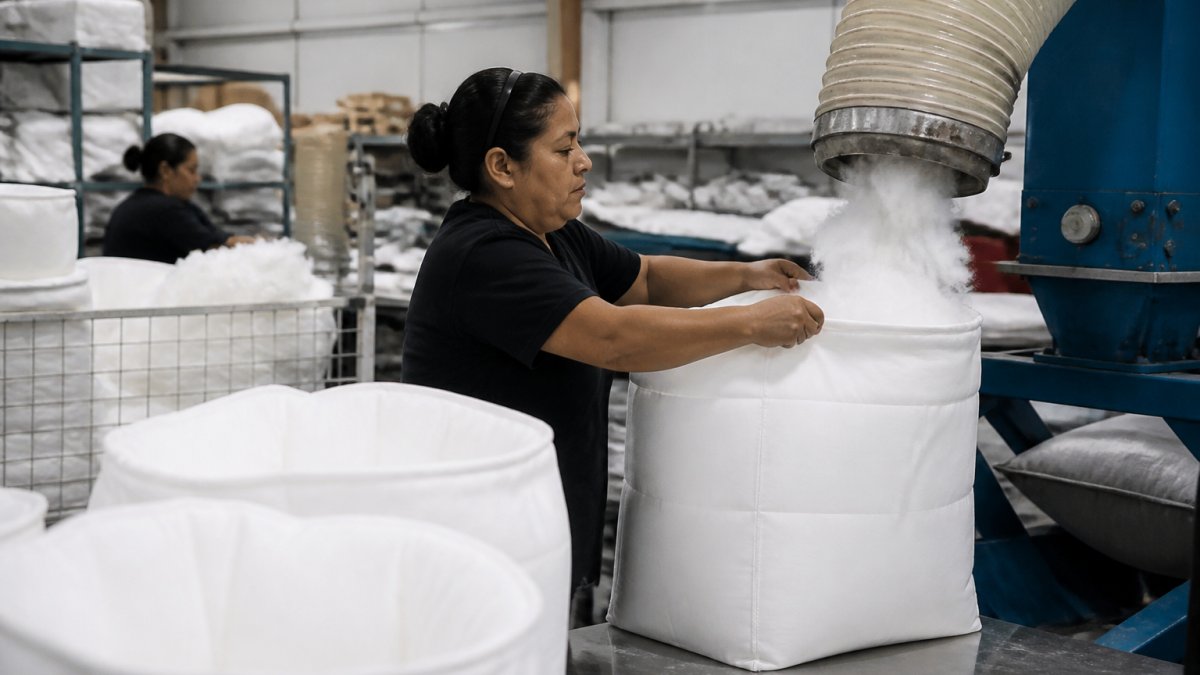
Bringing production home is a real operational shift, not a simple supplier swap. Sewing Contractor Solutions supports that shift with USA-based cut-and-sew manufacturing, flexible production runs, and direct communication with the ownership and production leadership who run your job. From pillow manufacturing and blow-fill services to heavy-duty sewn products built from specialty fabrics and webbing, the team helps brands launch new products and scale existing runs without the delays of overseas sourcing. Request a manufacturing quote from Sewing Contractor Solutions and start your transition with a partner who can actually deliver.
Frequently Asked Questions
How do cut and sew lead times compare between domestic and overseas production?
Domestic cut and sew manufacturing lead times typically run several weeks shorter than overseas because production, quality checks, and shipping all happen in one country. You avoid ocean freight schedules, customs clearance, and port delays that add weeks to overseas orders. Many U.S. manufacturers also offer faster reorders and smaller minimums, which helps you react to demand changes without holding months of inventory.
What regulatory requirements must be met for Made in USA labeling?
The FTC requires that any product labeled Made in USA be entirely manufactured or assembled in the United States with all significant parts and processing of U.S. origin. For textiles, this means fabric, cutting, sewing, and finishing must all happen domestically. Confirm your supply chain documentation before printing labels.
How can businesses offset the cost differences when moving production to the U.S.?
Higher domestic labor rates are real, but they are offset by lower freight, no tariffs or customs fees, reduced inventory carrying costs, and fewer quality failures from long-distance shipping. Many companies also save on travel for factory audits and rework. Start with your highest-margin or most time-sensitive products, run a total landed cost comparison, and negotiate volume pricing with your U.S. partner as runs grow.
What should I look for in a domestic contract sewing services provider?
Look for a manufacturer with experience in your specific product type, whether that is industrial sewn goods, medical textiles, or consumer apparel. Ask about their quality control process, production capacity, and ability to scale. Direct communication with production leadership matters because it shortens problem-solving time. Request references from customers with similar order sizes and confirm they can handle your fabric and customization requirements.
Request a Manufacturing Quote
Comments