
How to Choose Industrial Protective Textiles: 7-Step Guide

Last Updated: October 22, 2026
Quick Summary
To choose protective textiles, first assess workplace hazards and exposure risks, then match the fabric to the specific threat rather than expecting one cloth to resist everything. Confirm certification on the finished garment, compare test reports for abrasion, tear and tensile strength, and test durability under your real wash cycle before committing.
Certification applies to the finished garment, not the fabric roll, so ask for it on the assembled product.
Aramid fibers such as Nomex and Kevlar anchor many flame resistance programs for heat exposure.
Compare fabrics on cost per wear, since a material surviving twice the wash cycles can win on total value.
Wash samples to your real laundering schedule and re-test abrasion and tear strength afterward.
Test fit on real operators during real tasks, because gear that restricts movement leads workers to improvise.
Table of Contents
Step 1: Assess Workplace Hazards and Exposure Risks
Step 2: Match Protective Textiles to the Specific Hazard
Step 3: Understand Protective Clothing Standards and Certification
Step 4: Your Industrial Fabric Selection Guide for Performance and Quality
Step 5: Industrial Fabric Durability Testing Before You Commit
Step 6: Selecting High-Temperature Industrial Fabric for Heat and Flame Exposure
Step 7: Fabric Selection for Sewn Products: Comfort, Fit, and Mobility
Conclusion: Build a Repeatable Protective Textile Procurement Process
Frequently Asked Questions
Step 1: Assess Workplace Hazards and Exposure Risks
Choosing industrial protective textiles starts with one question: what is the worker actually exposed to?
A proper risk assessment maps every workplace hazard on the floor:
Chemical hazards: splashes, vapors, and contaminated dust
Heat and flame: molten splash, radiant heat, sparks
Hazardous dust and particles: fine debris that settles into seams
Impact and abrasion: sharp edges, rough handling, repeated rubbing
Cut and puncture risks from tools and materials
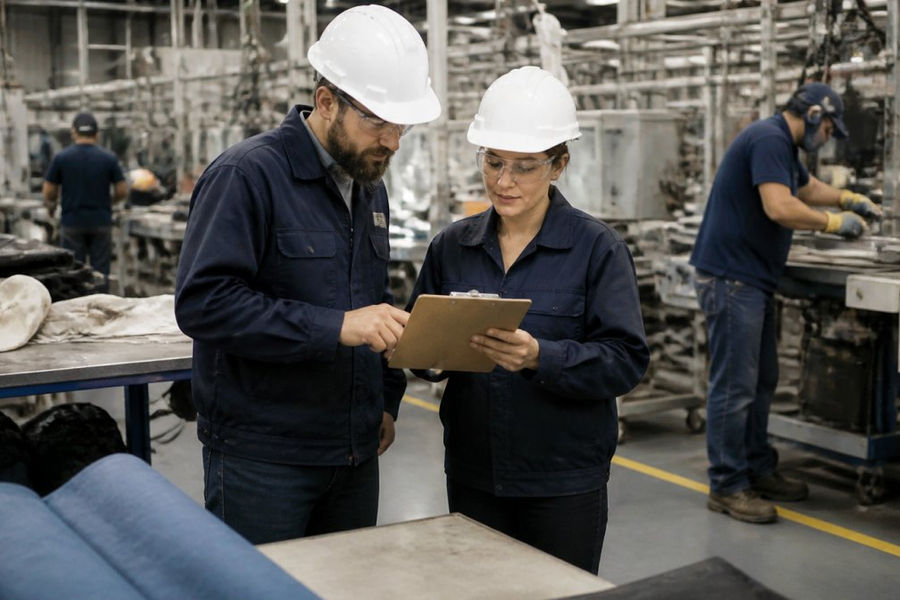
Walk the production line. Talk to the operators. Note where exposure assessment data already exists, and check incident logs for patterns.
Step 2: Match Protective Textiles to the Specific Hazard
Protective textiles are engineered fabrics built to resist a defined hazard, not all hazards at once. That distinction matters. A fabric that stops flame may offer poor chemical resistance, and a heavy abrasion-resistant weave may trap heat.
Match the material to the threat:
Chemical protection: coated and laminated protective fabric with low permeability
Heat protection and flame resistance: aramid fibers such as Nomex and Kevlar
Hazardous dust and particles: tightly woven, low-shedding constructions
Impact protection: layered or reinforced industrial textiles at high-wear zones
One fabric rarely covers two very different hazards well. When a job carries multiple risks, plan for layering rather than a single do-everything cloth.
Step 3: Understand Protective Clothing Standards and Certification
Protective clothing standards tell you what a garment has been tested to do. They do not tell you it suits your job. Read the certification against your hazard list, not in place of it.
Compliance in the U.S. runs through recognized bodies and test methods. The Occupational Safety and Health Administration sets employer duties for protective workwear, and the National Fire Protection Association publishes consensus standards for fire protection garments. ASTM International maintains many of the fabric testing methods used to certify performance.
Ask suppliers for three things:
The specific standard the garment is certified to
The test report behind the claim
The care instructions that keep certification valid
Pro Tip Certification applies to the finished garment, not the fabric roll. A certified cloth sewn with the wrong thread, seam, or closure can lose its rating. Ask for certification on the assembled product.
Step 4: Your Industrial Fabric Selection Guide for Performance and Quality
An industrial fabric selection guide is only useful if it ties fabric quality to measurable traits and tells you how those traits are tested. Judge protective performance on numbers and test methods, not hand feel.
Compare these industrial textiles metrics, and ask suppliers for the underlying test reports:
Metric | Common Test Method | What It Tells You | Why It Matters |
Abrasion resistance | ASTM D3884 (Taber) or ASTM D4157 (Wyzenbeek) | Cycles before wear-through | Predicts service life at high-wear zones |
Tear strength | ASTM D1424 (Elmendorf) or ASTM D5587 (trapezoid) | Force to propagate a rip | Shows durability under snags and stress |
Tensile strength | ASTM D5034 (grab) or ASTM D5035 (strip) | Breaking force of the fabric | Indicates seam and body integrity |
Fabric weight | ASTM D3776 | Mass per unit area | Balances protection and comfort |
Shrinkage | AATCC 135 (home laundering) | Percent change after wash | Keeps fit and coverage stable |
Colorfastness | AATCC 61 (laundering) | Resistance to fading | Maintains visibility and ID |
How to read the numbers. Test reports state the method, the conditioning, and the result. Compare like with like: a Taber abrasion result is not interchangeable with a Wyzenbeek result, and a grab tensile number is not the same as a strip tensile number. Ask for the report, not just the claim, and confirm the fabric lot tested matches the lot you will buy.
Textile construction and fibers drive these results. A tight weave resists particles. A heavier weight adds durability but costs breathability. The price-quality ratio only makes sense once you know which metric your hazard depends on. For a cut-and-sew program, also ask how the fabric behaves at the seam: tear strength at the stitch line often decides whether a garment survives the floor, not the flat-goods number alone.
Pro Tip Build a one-page spec sheet per fabric that lists the test method, the result, and the acceptance threshold for your hazard. That sheet becomes the reference for every reorder and every supplier comparison.
Step 5: Industrial Fabric Durability Testing Before You Commit
Industrial fabric durability testing answers one question: will this material survive your wash cycle and your floor? Lab data is a starting point. Real conditions decide, and the gap between the two is where lifecycle cost lives.
Run these checks before a full order:
Wash the sample to your real laundering schedule, using the actual detergent, water temperature, and dry cycle your facility uses.
Re-test abrasion resistance and tear strength after washing, and compare against the pre-wash baseline.
Flex and crease seams at stress points, and check bar-tack and box-X locations for thread breakdown.
Check protective performance after repeated cleaning, and confirm the care instructions still match how the garment is actually handled.
Inspect closures, zippers, and reflective trim, since these often fail before the fabric does.
Care and maintenance degrade protection quietly. Harsh detergents, high heat, and skipped repairs all shorten service life. Contamination from oils, chemicals, or embedded particles can also reduce performance in ways a wash will not fix. Build a laundering protocol, test against it, and set a retirement rule for garments that no longer meet the spec.
Lifecycle cost and total cost of ownership. The purchase price is only one input. Compare fabrics on cost per wear: divide the garment cost by the number of wash cycles it survives at spec, then add laundering, repair, and replacement labor. A material that survives twice as many wash cycles can beat a lower purchase price on total value alone, even when the per-yard cost is higher. Factor in downtime too: a garment pulled from service mid-shift costs more than the fabric ever did.
Procurement and implementation workflow. Once a fabric passes, document it. Run a wearer trial with a small group, collect fit and durability feedback, approve a production-ready sample, then roll out with a written spec that covers fabric, thread, seam type, and care. Reassess on a set schedule and after any process change, because a new detergent or a new hazard can invalidate an old approval.
Key Takeaway The cheapest fabric per yard is rarely the lowest cost over time. A material that survives twice as many wash cycles can beat a lower purchase price on total value alone.
Step 6: Selecting High-Temperature Industrial Fabric for Heat and Flame Exposure
High-temperature industrial fabric is specified by the exposure, not by reputation. Heat comes in different forms, and each calls for different material behavior.
Radiant heat: reflective surfaces and heat-stable fibers
Molten splash: dense weaves that shed droplets
Flame exposure: inherently flame-resistant aramid fibers
Aramid materials such as Nomex and Kevlar hold their structure under heat where common fabrics break down. That is why they anchor many flame resistance programs. Confirm the certification on the finished garment, and pair the fabric with compatible closures and thread.
We build heat-resistant sewn products at Sewing Contractor Solutions using aramid and other specialty materials, drawing on industrial sewing manufacturing and sewn component manufacturing to keep seams, closures, and thread matched to the fabric. The right textile selection here protects workers and keeps a certified garment certified.
Step 7: Fabric Selection for Sewn Products: Comfort, Fit, and Mobility
Fabric selection for sewn products fails when protection comes at the cost of wearability. A garment workers remove is a garment that protects no one.
Balance protective performance with comfort:
Breathability to manage heat stress on long shifts
Fit and mobility so workers can reach, bend, and lift
Garment design that reinforces high-wear zones without stiffness
Textile construction that stays flexible after washing
Worker safety depends on compliance as much as chemistry. If the gear restricts movement or overheats, people improvise. Test fit on real operators during real tasks. Adjust pattern and seam placement before you scale.
This is where a domestic partner helps. Direct communication with production leadership shortens the loop between a fit problem and a fix, and U.S. reshoring manufacturing keeps that feedback close to the floor.
Conclusion: Build a Repeatable Protective Textile Procurement Process
The hard part is not picking one fabric. It is repeating the choice across every run without losing quality. A documented procurement and implementation workflow turns a one-time decision into a dependable process.
At Sewing Contractor Solutions, we manufacture light- and heavy-duty sewn products, sewn components, and cut-and-sew goods for established businesses. Our team handles single-needle, double-needle, serger, box-X, and bar-tack sewing across materials from lightweight textiles to heavy PVC, aramid, and stretch fabrics. Flexible production runs, material sourcing support, and a central location keep replenishment fast and inventory under control.
Bring us a production-ready sample or established design, and we will help you scale it into commercial manufacturing. Request a manufacturing quote from Sewing Contractor Solutions and build a protective textile supply you can rely on.
Frequently Asked Questions
What are industrial protective textiles?
Industrial protective textiles are engineered fabrics used to make protective workwear and sewn components that shield workers from chemical, thermal, mechanical, and particulate hazards. They include aramid and flame-resistant blends, coated fabrics, high-tenacity nylons, and specialized laminates. Selection depends on the hazard profile, required safety standards, and the garment's construction. Buyers should evaluate fiber content, weight, finish, and test data rather than relying on a generic 'protective' label. The right textile balances protection, durability, and wearer comfort for the specific job tasks and working environment.
How do you choose fabric for an industrial protective application?
Start with a formal risk assessment to identify chemical, heat, flame, abrasion, and particulate hazards. Map each hazard to the relevant U.S. safety standard, then shortlist protective fabrics that carry the required certification. Review independent test data for abrasion resistance, tear strength, flame resistance, and chemical permeation. Confirm the fabric can be cut and sewn into the required garment design without losing protective performance at seams. Finally, compare total cost of ownership, including service life and care requirements, before committing to commercial production.
How can you verify that a protective textile meets the required performance standards?
Request the fabric supplier's certification documents and test reports from an accredited laboratory. Confirm the specific standard cited matches your hazard assessment, such as NFPA or ASTM test methods for flame resistance, thermal protection, or chemical permeation. Check that the reported results apply to the exact fabric weight, color, and finish you plan to buy, because finishes and dyes can change performance. Ask for a production-ready sample and, where feasible, commission independent verification testing before scaling to full commercial manufacturing.
What should buyers consider when sourcing protective textiles for sewn products?
Beyond fabric performance, evaluate the manufacturer's ability to sew the material without compromising protection. Heavy coatings, aramids, and laminates require specific needles, thread, and seam constructions such as double-needle or bar-tack reinforcement. Confirm the supplier can source consistent fabric lots and provide traceability. Consider domestic manufacturing for faster replenishment, lower inventory risk, and direct communication during production. Pricing depends on quantity, fabric requirements, and delivery schedules, so request a quote based on your actual production plan rather than comparing headline fabric prices alone.
Discuss Your Production Project
Comments