
Is Domestic Contract Sewing Worth It for Startups

Table of Contents
What Makes Domestic Contract Sewing Different
Domestic vs Overseas Textile Manufacturing: The Real Trade-offs
Understanding Sewing Contractor Minimum Order Quantities
Cut and Sew Manufacturing Lead Times and Delivery Speed
The Real Cost Analysis: Labor, Overhead, and Profit Margins
The Hidden Costs of Overseas Manufacturing
Domestic Contract Sewing Economics
Break-Even Calculator Framework
Real-World Example: Sewn Apparel Startup
Profit Margin Implications
Quality Control and Direct Communication Advantages
Is Domestic Contract Sewing Right for Your Startup
When Domestic Contract Sewing Makes Sense
Vetting Checklist: How to Evaluate a Domestic Sewing Contractor
The Hybrid Model: Domestic Prototype, Overseas Production
Start by Calculating Your True Total Cost
Frequently Asked Questions
Last Updated: September 19, 2026
What Makes Domestic Contract Sewing Different
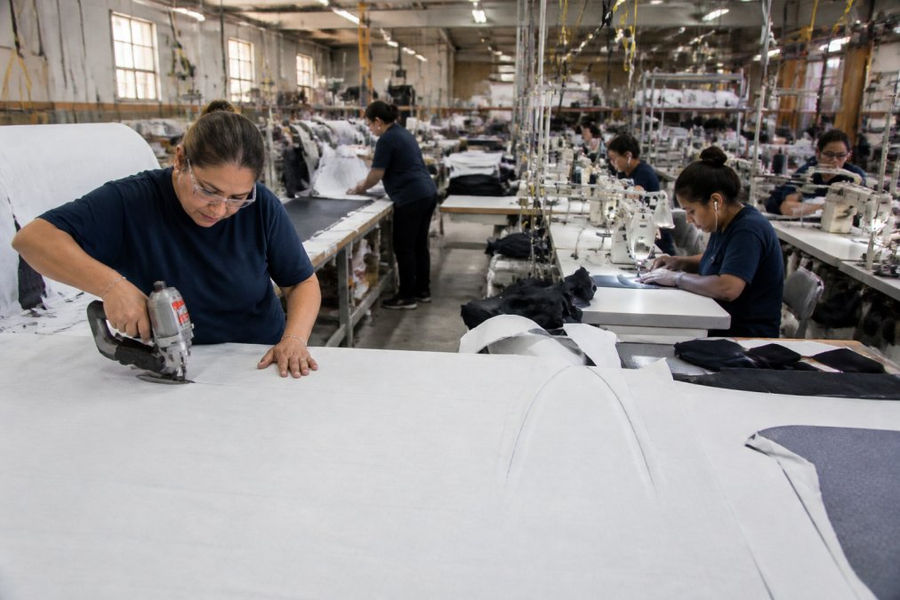
Domestic contract sewing trades lower per-unit labor costs for speed, communication clarity, and supply chain predictability. The real question isn't whether it's cheaper per unit, it rarely is, but whether the total business impact justifies the premium.
Pro Tip Most startups assume overseas manufacturing is always cheaper. The real comparison requires factoring in inventory carrying costs, tariff exposure, and the cost of expedited shipping when you miscalculate demand. That's where domestic contract sewing often wins financially.
Domestic vs Overseas Textile Manufacturing: The Real Trade-offs
Overseas manufacturing has lower per-unit labor costs but includes inventory financing, tariff exposure (25%+ on apparel), extended lead times (12-16 weeks), and quality variability. Domestic contract sewing costs more per unit but offers 4-8 week lead times, smaller batches matched to demand, zero tariffs, and real-time communication with production teams.
Factor | Overseas Manufacturing | Domestic Contract Sewing |
Lead Time | 12-16 weeks | 4-8 weeks |
Minimum Order Quantity | Often 5,000-10,000 units | Flexible, as low as 500-1,000 |
Tariff Exposure | High (25%+ on apparel) | None |
Quality Communication | Email, time zone delays | Direct phone/video with production team |
Inventory Carrying Costs | Higher (longer lead times) | Lower (smaller, faster orders) |
Rush Fees | Expensive expedited shipping | Shorter transit, lower cost |
Understanding Sewing Contractor Minimum Order Quantities
Overseas manufacturers typically require 5,000-10,000 unit minimums; domestic partners often accept 500-2,000 unit runs. Smaller batches mean higher per-unit costs but eliminate dead inventory financing and let you prove demand, refine, and scale confidently.
Key Takeaway Minimum order quantities are the biggest constraint for startups. Domestic contract sewing partners that accept smaller runs give you the cash flow and flexibility to grow without betting the company on a single production run.
Cut and Sew Manufacturing Lead Times and Delivery Speed
Overseas cut and sew manufacturing requires 12-16 weeks; domestic contract sewing compresses this to 4-8 weeks. Direct communication surfaces problems earlier and resolves them faster. Faster cycles mean lower inventory financing and smaller, frequent orders matched to actual demand.
The Real Cost Analysis: Labor, Overhead, and Profit Margins
Labor is one component of total cost. Factoring in lead time financing, tariffs, inventory carrying costs, and rework changes the picture.
The Hidden Costs of Overseas Manufacturing
Direct manufacturing cost: $8/unit Tariff exposure: 25% on apparel = $2/unit Inventory financing: 10,000 units on 14-week lead time = $0.32/unit Quality rework/scrap: 3% loss = $0.24/unit Expedited shipping/customs: $1-2/unit
True total cost: $11.56-$12.56/unit, not $8.
Domestic Contract Sewing Economics
Direct manufacturing cost: $12/unit Tariff exposure: $0 Inventory financing: 1,000 units on 6-week lead time = $0.15/unit Quality rework/scrap: 0.75% loss = $0.09/unit Domestic shipping: Minimal
Break-Even Calculator Framework
To determine which model works for your startup, use this framework:
Step 1: Calculate your true overseas cost per unit
Manufacturing cost per unit: $_____
Tariff rate (check current rates at U.S. International Trade Commission): % × manufacturing cost = $_
Inventory carrying cost: (Total order cost × 0.12 ÷ 12 months × lead time in months) ÷ units ordered = $_____
Scrap/rework allowance (assume 3%): (Manufacturing cost × 0.03) = $_____
Expedited shipping buffer (assume $1-2 per unit): $_____
Total overseas cost per unit: $_____
Step 2: Calculate your domestic cost per unit
Manufacturing cost per unit: $_____
Tariff rate: 0%
Inventory carrying cost: (Total order cost × 0.12 ÷ 12 months × lead time in months) ÷ units ordered = $_____
Scrap/rework allowance (assume 0.75%): (Manufacturing cost × 0.0075) = $_____
Domestic shipping: $_____
Total domestic cost per unit: $_____
Step 3: Calculate break-even volume
Difference in per-unit cost (domestic minus overseas): $_____
Monthly sales volume you can realistically achieve: _____ units
If domestic cost per unit is higher, you break even when the faster lead time allows you to avoid one full production cycle of inventory financing per year. For most startups, this happens at 2,000-5,000 units per month.
Real-World Example: Sewn Apparel Startup
Example: Custom athletic wear startup
Overseas: $8/unit, 10,000-unit minimum, 14-week lead time = $115,600 investment, 14-week delay, $5,787 carrying cost = $121,387 first-year cost
Watch Out The per-unit cost comparison is a trap. Calculate total cost of capital, not just per-unit manufacturing cost. A $12 unit cost on a domestic run that you sell through in 8 weeks is more profitable than an $8 unit cost on an overseas run that you're still financing 6 months later.
Profit Margin Implications
Lower inventory financing and faster feedback loops let you operate on tighter margins domestically. Domestic manufacturing also eliminates overhead from quality inspections, communication delays, customs, tariffs, and currency risk.
Quality Control and Direct Communication Advantages
Defects discovered weeks after overseas arrival are nearly impossible to address. Domestic contract sewing catches issues during production through direct communication. You can visit the facility and adjust specifications mid-run, impossible with overseas manufacturers locked into initial specs.
Is Domestic Contract Sewing Right for Your Startup
The decision comes down to: Does domestic contract sewing fit your business model and cash flow, and have you vetted the contractor thoroughly?
When Domestic Contract Sewing Makes Sense
Domestic contract sewing makes sense if you're bootstrapped, testing products, or serving customers with specific quality/customization needs. It may not work for commodity products at massive scale (100,000+ units). Domestic advantages apply to direct-to-consumer and small retail; large retailers with long lead times and massive minimums favor overseas.
Vetting Checklist: How to Evaluate a Domestic Sewing Contractor
Finding a legitimate, capable contractor is critical. Use this checklist to evaluate before committing:
Operational Capacity & Experience
How many years in business? (Look for 5+ years; newer shops may lack process discipline)
Current production capacity in units per week? Does it match your volume needs?
Experience with your product category?
Can they provide 3-5 references? Call and ask about lead time reliability, quality consistency, and responsiveness.
Do they have documented SOPs for quality control, cutting, sewing, and inspection?
Quality Control Systems
In-process quality checks or only final inspection? (In-process is better.)
Documented defect rate? (Should be under 2%; if they can't tell you, that's a red flag.)
Dedicated QC staff or ad-hoc checks?
Process for handling defects? Rework at no charge?
Can you visit the facility? (Refusal is a major red flag.)
Communication & Responsiveness
Primary point of contact? (Direct access to ownership or production leadership is ideal.)
Communication channels and response time expectations?
Proactive production updates or do you have to ask?
Can they accommodate mid-production spec changes?
Ask them to walk through a recent production run: timeline, issues, resolution. (Reveals problem-solving approach.)
Financial Stability & Contracts
Do they require a deposit, and if so, how much? (Industry standard is 30-50% upfront; anything higher is a risk.)
What is their payment terms? (Net 30 is standard; anything requiring full prepayment is a red flag.)
Do they provide a written quote that specifies unit price, MOQ, lead time, and payment terms? (If they're vague on paper, they'll be vague in execution.)
Do they require a manufacturing agreement or quality assurance contract? (A contractor who insists on a written agreement is more professional than one who operates on handshakes.)
Have they ever had legal disputes with clients? (Ask directly; check with the Better Business Bureau or local business registries.)
Intellectual Property & Confidentiality
Do they have a confidentiality or non-disclosure agreement (NDA) they can provide? (If not, ask them to sign yours before you share designs.)
Who owns the patterns, dies, or tooling if you provide them? (You should retain ownership; the contractor should hold them in trust.)
What is their policy on producing the same product for competing brands? (Some contractors will, some won't; clarify this upfront.)
Red Flags: Walk Away If You See These
Contractor cannot or will not provide references
Facility visit is refused or heavily restricted
They cannot articulate their quality control process
They pressure you to place a large order immediately
They are vague about lead times or pricing
They have no written agreement or contract template
They require 100% prepayment or payment in cash only
Communication is slow, unclear, or goes through a middleman
They have no experience with your product category
They are unwilling to sign an NDA or discuss IP ownership
The Hybrid Model: Domestic Prototype, Overseas Production
Many startups find a middle path: use a domestic contractor for prototyping, sampling, and small initial production runs to validate the product and market. Once demand is proven and specifications are locked, move to overseas manufacturing for scale. This model minimizes risk because you've already worked out design issues and quality standards with a domestic partner before committing to a large overseas order.
Start by Calculating Your True Total Cost
Before you approach any contractor, calculate your true total cost using the framework from the previous section. Then compare that to the cost of domestic contract sewing with smaller, faster production runs. The answer often surprises startups who assumed overseas manufacturing was always cheaper.
Frequently Asked Questions
What are the primary benefits of using domestic contract sewing for startups?
Domestic contract sewing offers faster lead times, direct communication with ownership and production leadership, and reduced delays compared to overseas manufacturing. Startups benefit from shorter turnaround times when product changes are needed, easier quality control oversight, and the ability to scale production runs without the logistical complexity of international shipping. These advantages matter most when you need flexibility or when tariffs and freight costs have eroded overseas savings.
What is the typical minimum order quantity for domestic sewing contractors?
Minimum order quantities vary by contractor and product complexity. Many domestic sewing contractors accommodate smaller production runs, and some may work with even smaller batches for specialized or high-complexity products. The key is communicating your actual production needs upfront. Domestic manufacturers often have more flexibility on MOQs than overseas counterparts, especially for established relationships or recurring orders. Contact contractors directly with your specifications to understand their capacity for your batch size.
How does domestic manufacturing impact lead times compared to overseas production?
Domestic production typically cuts lead times significantly. While overseas manufacturing may take longer including shipping, domestic contract sewing often delivers faster, depending on production complexity and current capacity. This speed advantage becomes critical when you need to respond to market demand quickly, test new products, or manage supply chain disruptions. Faster turnaround also reduces work-in-progress inventory and ties up less capital during production cycles.
Is domestic contract sewing more cost-effective for small-batch production?
For small batches, domestic contract sewing often becomes cost-competitive or superior when you factor in tariffs, shipping costs, and lead time expenses. While overseas labor costs are lower, domestic manufacturing eliminates international freight, import duties, and the inventory carrying costs of longer production cycles. The math shifts further in favor of domestic production when you need quick turnaround, frequent design changes, or have supply chain reliability concerns. Calculate your total landed cost, not just per-unit labor rates, to get the true picture.
Request a Manufacturing Quote
Comments